
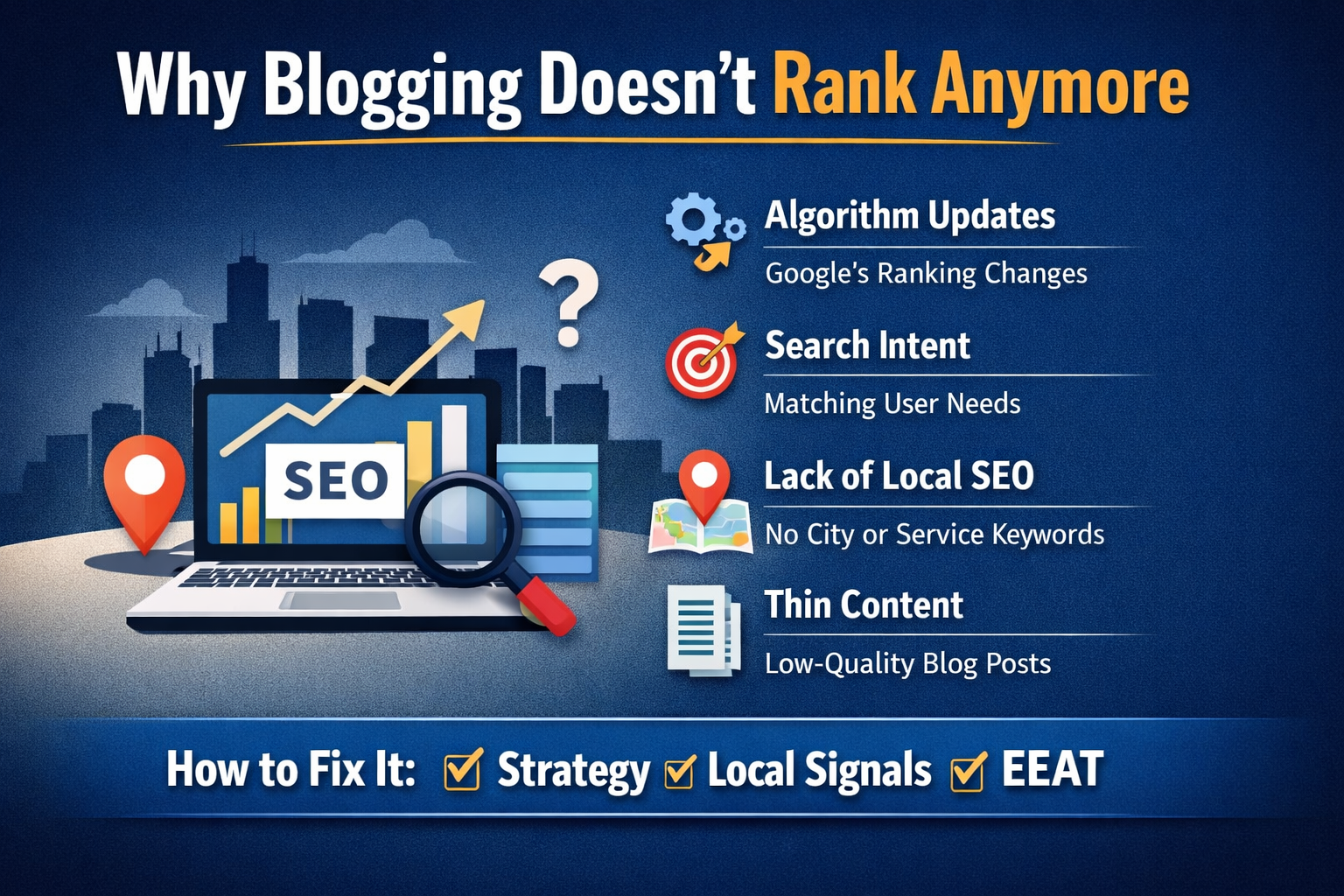
Many businesses believe that simply publishing blog posts will automatically bring traffic from Google. The truth is that blogging still works for SEO, but the traditional “publish more articles” approach no longer guarantees rankings.
Google’s algorithms now prioritize search intent, topical authority, EEAT signals, and local relevance. If your blog lacks these elements, it will struggle to rank — especially in competitive markets across the United States.
In this guide, we will explain why blogging doesn’t rank anymore, what changed in Google’s algorithm, and how businesses in the USA can fix their blogging strategy to generate real organic traffic and leads.
What Changed in Google Search?
Google No Longer Rewards Random Blog Publishing
Years ago, businesses could publish many blog posts targeting basic keywords and still gain traffic. Today, Google evaluates content using more advanced signals.
Google now analyzes:
- Content quality
- Search intent match
- Website authority
- Topic expertise
- User engagement
- Local relevance
If a blog post does not provide clear value and expertise, Google will likely rank another page that does.
Search Intent Now Drives Rankings
Search intent refers to what the user actually wants when searching on Google.
For example:
Someone searching for
“Why blogging doesn’t rank anymore”
likely wants:
- An explanation of Google algorithm changes
- SEO strategy insights
- Practical solutions
If your content does not satisfy this intent, Google will not rank it.
Why Many Blogs Fail to Rank in the USA
Across cities like Austin, Dallas, Chicago, Phoenix, and Miami, many businesses invest time and money in blogging but see little return.
Based on my experience working with local companies, there are several common problems.
1. No SEO Strategy Behind the Blog
One of the most common mistakes is writing blog posts without keyword research.
Example mistake:
Publishing random posts like:
- “Tips for Growing Your Business”
- “Digital Marketing Ideas”
These topics are too broad and competitive.
Instead, successful blogs target specific search queries like:
- Why SEO content doesn’t rank
- Local SEO strategies for small businesses
- How Google ranks local service pages
2. Blogs Ignore Local SEO Signals
Businesses often forget that local relevance is critical for ranking.
For example, a business in Dallas might publish:
“SEO Tips for Small Businesses”
But a stronger local version would be:
“SEO Tips for Small Businesses in Dallas, Texas”
This simple change signals geographic relevance to Google.
Local SEO signals include:
- City names
- Service areas
- Local examples
- Google Business Profile connections
3. Lack of Topical Authority
Google prefers websites that demonstrate expertise in a specific topic.
Many companies publish blogs on random topics, which weakens their authority.
For example, a business website might publish:
- SEO blog posts
- Cooking recipes
- Social media tips
- Personal opinions
This creates no clear topical authority.
Successful SEO websites build topic clusters around their services.
Example cluster for SEO services:
- Local SEO guide
- Google Maps ranking factors
- Technical SEO for local websites
- SEO content strategy
This signals expertise.
Real Example: Why Two Similar Blogs Rank Differently
Let’s consider a real-world scenario.
Two businesses in Atlanta, Georgia publish blog content.
Business A publishes weekly articles but does not optimize them.
Problems include:
- No keyword targeting
- No internal links
- No structured headings
- No location mentions
Business B publishes fewer posts but optimizes them carefully.
Their strategy includes:
- Clear search intent targeting
- Internal linking to service pages
- Structured headings and schema
- Local examples
After several months, Business B consistently ranks higher in Google results.
This demonstrates an important lesson: quality and structure matter more than quantity.
Local SEO Challenges for Businesses Across the USA
Local businesses often face unique SEO challenges.
These include:
- Strong regional competition
- Location-specific search behavior
- Limited domain authority
Cities such as:
- Dallas, Texas
- Miami, Florida
- Chicago, Illinois
- Phoenix, Arizona
- Seattle, Washington
have highly competitive search environments.
To rank locally, blog content must reflect local context and customer needs.
How to Fix a Blog That Isn’t Ranking
If your blog is not generating traffic, the strategy must change.
Below are five practical steps businesses can take.
Step 1: Perform Proper Keyword Research
Every blog should target a clear keyword.
Example keyword variations include:
- why blogging doesn’t rank anymore
- blogging SEO strategy
- why blog posts fail to rank
- how to optimize blog posts for SEO
Tools like keyword research platforms help identify search demand and competition levels.
Step 2: Match Search Intent
Before writing a blog post, ask:
“What problem does the user want solved?”
Your article should:
- explain the issue
- provide solutions
- guide readers toward next steps
Content that solves real problems ranks better.
Step 3: Build Topic Clusters
Instead of publishing random posts, build a content ecosystem.
Example structure:
Main topic
SEO content strategy
Supporting articles
- Why blog posts fail to rank
- On-page SEO checklist
- How internal linking improves rankings
- Local SEO ranking factors
This approach strengthens topical authority.
Step 4: Optimize for Local SEO
Local businesses should include geographic relevance in their content.
Examples include:
- mentioning cities
- referencing local business conditions
- discussing local competition
For example:
A blog targeting Los Angeles businesses may reference:
- local market competition
- regional search demand
- neighborhood service areas
This helps Google understand where your expertise applies.
Step 5: Strengthen Internal Linking
Internal links connect your blog posts with service pages.
This helps Google understand:
- page relationships
- topical authority
- site structure
Example internal links:
- Local SEO services
- SEO audit services
- Technical SEO guide
Internal linking also improves user navigation.
GEO SEO: Service Areas Across the United States
Businesses across the USA benefit from strategic blogging.
Our SEO strategies support companies in cities such as:
- Dallas
- Austin
- Houston
- Atlanta
- Miami
- Los Angeles
- Chicago
- Denver
We also work with surrounding communities and suburbs including:
- Plano (near Dallas)
- Naperville (near Chicago)
- Glendale (near Los Angeles)
- Sandy Springs (near Atlanta)
Local search behavior often varies by region, which is why SEO strategies must be adapted for each city and service area.
Cost of Fixing a Poor Blogging Strategy
Many businesses ask how much it costs to fix SEO content problems.
Typical pricing ranges include:
Basic SEO consultation
$200 – $500
Monthly SEO strategy management
$800 – $3,000+
Full-service SEO campaigns
$3,000 – $7,000+ per month
Costs depend on factors such as:
- website size
- competition level
- technical issues
- content volume
However, the right strategy often generates long-term organic traffic and leads.
Prevention Tips: How to Avoid Blogging SEO Failure
Businesses can prevent ranking issues by following these best practices.
Blog Optimization Checklist
Before publishing any article, confirm:
- Keyword research is complete
- Search intent is clear
- Headings are structured (H2 / H3)
- Internal links are added
- Location relevance is included
- Helpful information is provided
Consistency and quality are key.
When to Call a Professional in USA
Some situations require professional SEO assistance.
You should consider hiring an SEO expert if:
- Blog posts receive zero traffic
- Google Search Console shows no impressions
- Competitors dominate search results
- Your website structure is unclear
- Technical SEO issues exist
Professional SEO experts can diagnose issues and create a data-driven content strategy that aligns with Google’s ranking signals.
Why Choose Us for SEO Services in USA
Our SEO service focuses on practical strategies that produce measurable results.
We help businesses improve visibility by:
- Conducting in-depth SEO audits
- Building topic clusters
- Optimizing on-page SEO
- Improving local search signals
- Creating high-quality SEO content
Our experience working with businesses across multiple U.S. markets allows us to understand regional competition and search behavior.
We focus on strategies that build long-term organic traffic growth rather than short-term ranking tricks.
Ready to Fix Your Blogging Strategy?
If your blog posts are not generating traffic, the problem is rarely blogging itself. The issue is usually strategy, optimization, or search intent alignment.
A well-structured SEO strategy can turn blog content into consistent organic traffic and lead generation.
If you want to improve your SEO performance, explore our professional SEO service solutions designed for businesses across the USA.